13. mars 2026
The Ritual of Connection: How weekly rituals unlock Peace of Mind, Wellbeing, and the Relationships that matter most.
In the rush of modern life, we often defer what matters most. We postpone the deep conversation with our partner, the long-overdue catch-up with a parent, or the slow afternoon with a best friend. We tell ourselves there will be time later, when things slow down. But things rarely slow down on their own.
What psychology and neuroscience increasingly confirm is that our well-being is not built from grand gestures or perfect moments. It is built, quietly and consistently, from ritual. From showing up, week after week, with intention.
This is the premise behind a powerful new approach to relationships and mental health: the weekly ritual. And it is exactly what the keepsake journal we are about to share with you was designed to support.
Why Ritual Is the Architecture of Wellbeing
The word ritual often conjures images of ceremony or religion, but in psychology, ritual refers to something far more intimate: a repeated, meaningful behavior that signals to your brain and body that something important is happening.
Research in behavioral neuroscience shows that rituals reduce anxiety by creating predictability. When we know a meaningful experience is coming (a weekly check-in, a shared reflection, a moment set aside) our nervous system anticipates safety. We exhale before we even begin.
Dr. Michael Norton of Harvard Business School has extensively studied how rituals improve performance, reduce grief, and enhance enjoyment. His findings suggest that even simple, repeated behaviors (when imbued with intention) create a psychological buffer against stress and disconnection.
When we apply this to our relationships, something remarkable happens. A weekly ritual shared between two people becomes a container for trust, vulnerability, and growth. It says: this relationship is worth showing up for, again and again.
Introducing the Weekly Keepsake Journal
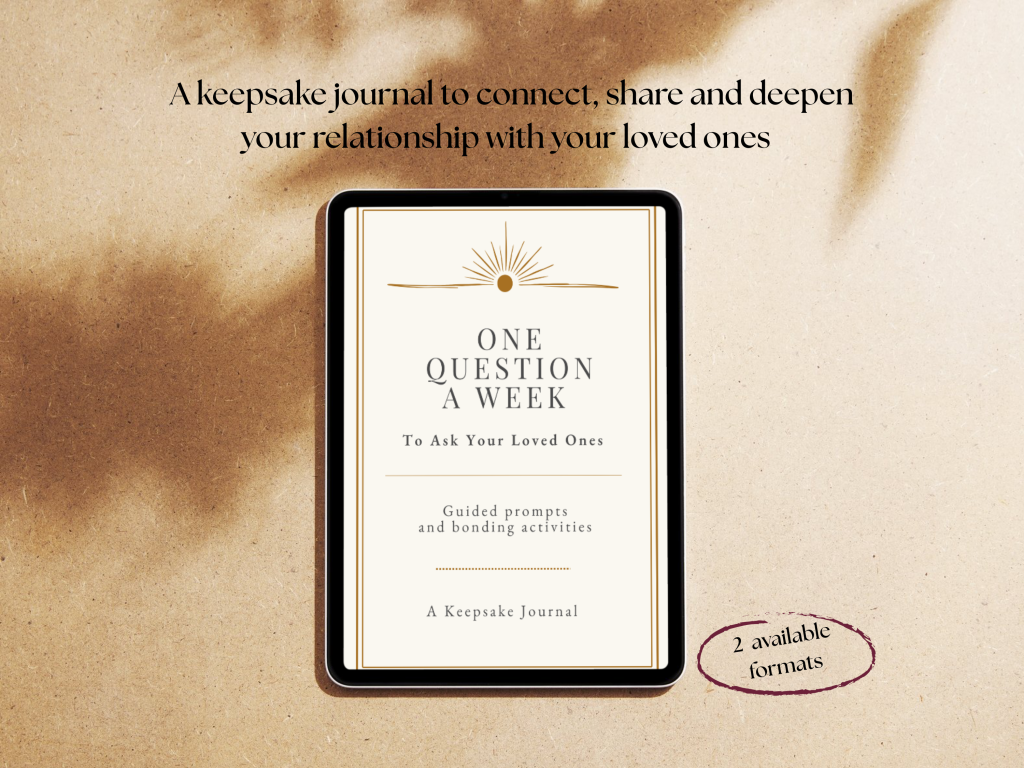
The weekly keepsake journal was created with all of this research in mind — and with something else, too: the belief that beautiful things are worth preserving.
Each week, you and your chosen person receive a thoughtfully crafted question — the kind that opens doors rather than closes them. Questions about memory and dreams, about values and fears, about the small joys that define a life. These are not trivial prompts. They are carefully designed invitations into the interior world of someone you love.
Alongside each question, you will find a bonding activity — something to do together before you reflect. Something to make the week feel alive with shared intention.
And then, you write. You record your answers, your reflections, the moments that surprised you. Over weeks and months, you are not just deepening a relationship — you are building an archive of it. A keepsake, in the truest sense: something to keep.
This is not a productivity tool. It is not a self-optimization system. It is something older and more essential: a ritual of love, made simple enough to sustain, rich enough to transform.
The Psychology of Reflection: Why Questions Change Everything
At the heart of the weekly ritual journal is a deceptively simple tool: a question. Not small talk, not a to-do list but a genuine, thoughtful prompt designed to invite reflection and draw out the stories, values, and inner worlds we rarely share.
Psychologists call this kind of structured self-disclosure a cornerstone of intimacy. Arthur Aron's landmark research on interpersonal closeness (the study that inspired the famous 36 Questions to Fall in Love) demonstrated that guided mutual vulnerability accelerates emotional connection faster than years of casual interaction.
Questions work because they give us permission. Permission to be curious. Permission to be honest. Permission to be surprised by someone we thought we already knew.
Weekly reflective questions serve another function, too: they anchor our sense of self. Journaling and self-reflection are consistently linked in the research to reduced symptoms of anxiety and depression, improved emotional regulation, and greater clarity of values. When we reflect together, we multiply these benefits while simultaneously deepening our bond.
Bonding Activities: When Doing Becomes Remembering
The weekly journal pairs each reflective question with a bonding activity — a shared experience designed not just to be enjoyed in the moment, but to be reflected upon together afterward.
This combination is not accidental. It draws on the well-established psychology of shared experience. When two people participate in a novel or meaningful activity together, their brains release oxytocin, sometimes called the bonding hormone, and encode the experience as emotionally significant. Reflecting on that activity afterward deepens the encoding, transforming a fleeting moment into a lasting memory.
Think of the difference between a holiday you rushed through versus one where you sat quietly with someone you love at the end and said, 'What was your favorite part?' The second holiday lives longer. The second relationship grows deeper.
Bonding activities do not need to be elaborate. A shared walk. A meal cooked together from a new recipe. An evening of looking through old photographs. What matters is not the activity itself, but the quality of presence you bring to it — and the reflection that follows.
Choosing Your Person: The Gift of Focused Attention
One of the most meaningful aspects of this journal is the invitation to choose your person. A partner. A parent or child. A closest friend. A sibling you have grown distant from.
In an age of fragmented attention; notifications, feeds, shallow interactions multiplied across dozens of platforms — choosing one person and committing to a weekly ritual of depth is a radical act of love.
Psychologist John Gottman's research on relationships found that the single greatest predictor of relationship health is not how little couples fight or how often they say 'I love you.' It is the quality and frequency of what he calls 'turning toward' small moments of genuine interest and attention directed at the other person.
Relationships, like gardens, do not sustain themselves. They require tending. The weekly ritual journal gives you the tools and the gentle structure to tend yours.
Begin This Week
You do not need the perfect moment to begin. You do not need a special occasion, a cleared schedule, or a life already in order. You only need this week, and the person you are choosing to show up for.
The ritual of connection is available to all of us, at any stage of any relationship. A parent reconnecting with a grown child. A long-married couple finding new depth. Friends separated by distance or time. The grief of disconnection is common to the human experience, and so is the joy of finding your way back.
Weekly rituals do not solve everything. But they create something powerful and rare: a steady, reliable current of care flowing between two people. Week by week, question by question, memory by memory — that current shapes a life.
Your journal is waiting. So is your person.